Space Is Cold. Keeping an AI Data Center Cool Is Hard.
A vacuum flask, a very hot computer, and the enormous wings that could decide whether AI belongs in orbit. A visual guide to the science behind the pitch.
The most useful object for understanding a data center in space may already be in your kitchen.
A vacuum flask.
Pour in hot coffee, close the lid, and carry it into the cold. Hours later, the coffee can still be warm. Between the flask’s walls is a near-vacuum: very little matter to carry heat across the gap. Reflective surfaces slow another escape route, thermal radiation. The absence of air is part of what keeps the heat in. NASA explains the flask analogy here.
Now consider the pitch for putting computers in orbit. There is plentiful sunlight. There is no neighborhood water supply to draw from. And beyond the spacecraft lies the cold darkness of space.
The last part sounds like a gift to anyone who has ever heard a laptop fan struggling.
It is also where the trouble begins.
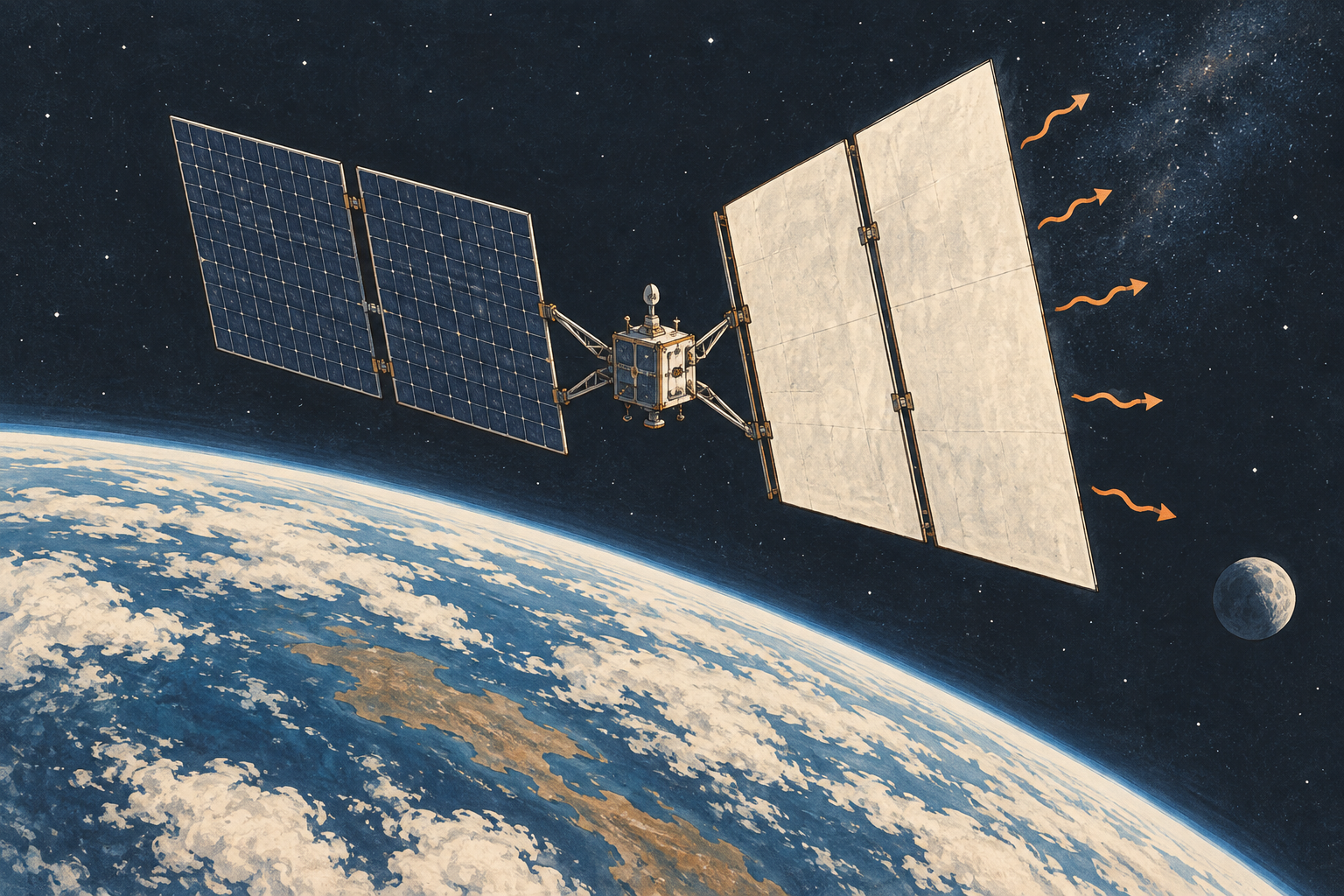
The missing breeze
Put your hand near a warm laptop. The moving air carries energy away from the machine. A liquid-cooled computer takes a different first step: fluid picks up the heat. Somewhere downstream, the cooling system must still release it to the surroundings.
An orbiting computer has no useful outside breeze. Vacuum is not a bath of freezing air. But heat has another way to travel: radiation, energy carried by electromagnetic waves. Sunlight crosses space to warm your face. Warm spacecraft surfaces send energy outward, mostly as infrared light your eyes cannot see. NASA’s explanation of cooling in a vacuum
That means both sweeping claims miss something. “Space makes cooling effortless” overlooks the missing air. “Nothing can cool in a vacuum” overlooks radiation.
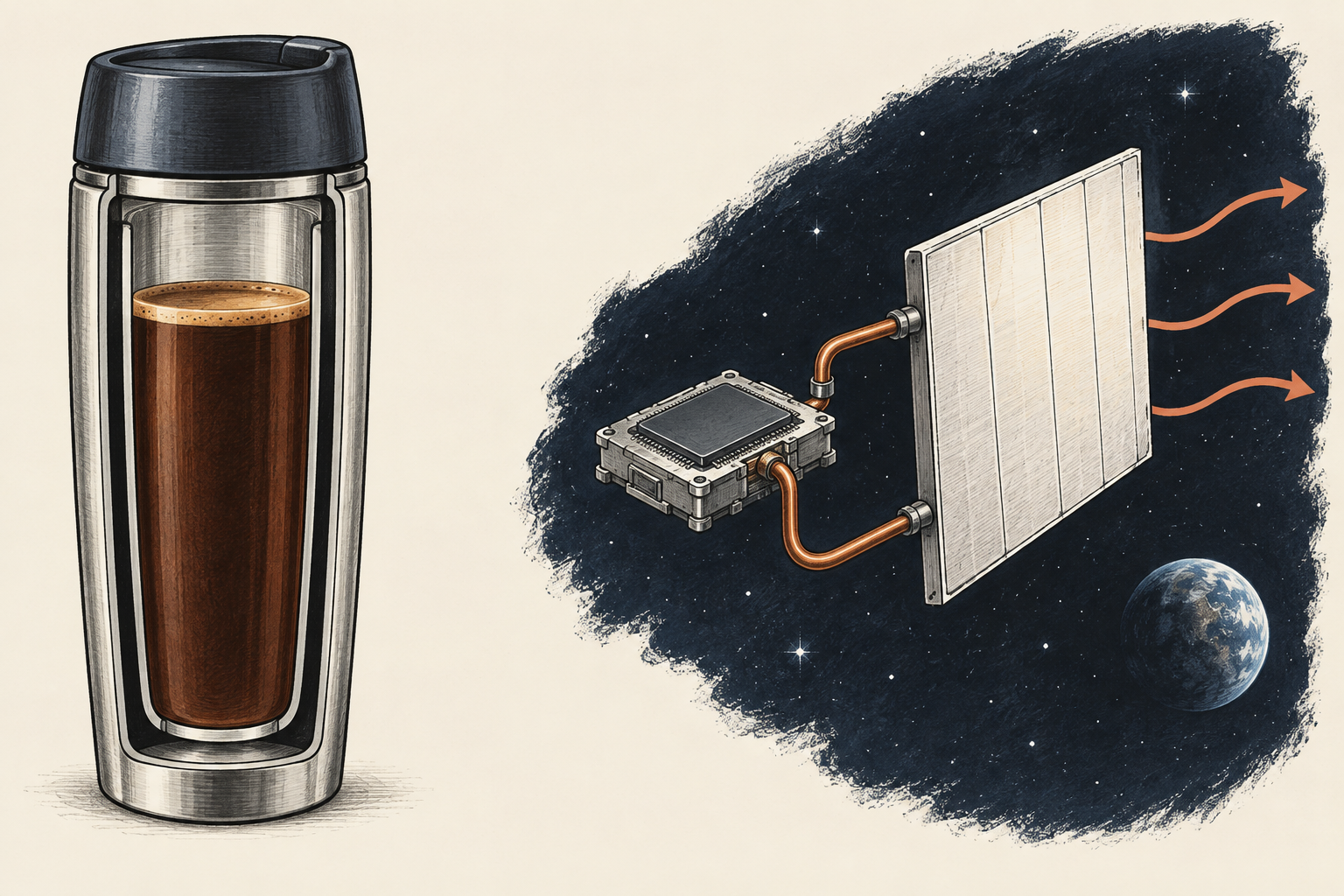
Spacecraft engineers already know how to work with this. On the International Space Station, water circulates inside habitable modules and transfers heat to an external ammonia system. Radiators then release that heat to space. Properly designed, sealed coolant loops do not need outside air to move heat. NASA’s ISS reference guide, thermal-control section
Here is the basic journey for a liquid-cooled orbital computer:
flowchart TD
  accTitle: The journey of heat from a computer to space
  accDescr: Heat moves from the chip through a cold plate and coolant loop to a radiator. The radiator emits infrared energy into space, and cooled fluid returns to the cold plate.
  A["1. CHIP<br/>Electricity becomes heat"] --> B["2. COLD PLATE<br/>Collects the heat"]
  B --> C["3. COOLANT<br/>Carries heat outside"]
  C --> D["4. RADIATOR<br/>Emits infrared light"]
  D --> E["SPACE"]
  D -. "Fluid returns" .-> B
  class A anchor;
This is a simplified heat path, not a plumbing drawing. Fluid recirculates; it is not deliberately dumped into space.
The difficult question is how large, heavy, and dependable that last piece of equipment must be when the computer becomes a data center.
The machine is also a heater
The workhorse in many AI computers is a GPU, a processor that performs many calculations at once. For cooling calculations, almost all the electrical power consumed by the computing equipment eventually becomes heat. Useful answers do not carry away most of that energy.
Imagine a computing load of one megawatt: one million watts, comparable in heating power to 1,000 hypothetical 1,000-watt electric heaters running together. This is a power comparison, not a claim about the physical number of servers.
Leave those heaters running, and heat has to leave at roughly the same rate it arrives. Pumps, power electronics, and communications add their own demands. A cooling system sized only for the chips will miss part of the bill. Power accounting in Turyshev’s orbital-data-center analysis
A radiator’s capacity depends on its surface area, its temperature, and how effectively its surface emits radiation—a property called emissivity. The temperature part has a surprising twist: a hotter radiator can reject much more heat from the same area. This follows the Stefan–Boltzmann law. NASA’s technical treatment
We calculated three examples for exactly one megawatt of waste heat:
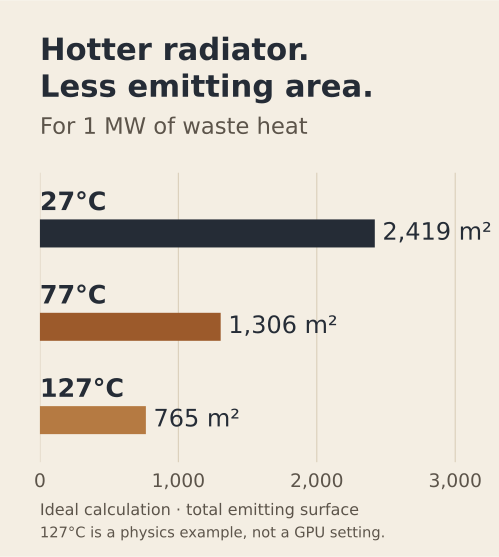
At about 77°C, the ideal calculation requires roughly 1,300 square meters of emitting surface. A single square of that area would be about 36 meters on each side: approximately 118 feet. That is for one megawatt of heat, before adding the rest of the spacecraft’s heat load.
These are emitting areas, not automatically the footprint of the wings. If both faces of a panel can radiate effectively, both contribute. If one faces a warm spacecraft or Earth, the calculation changes. Sunlight and reflected sunlight also add heat. A radiator needs a favorable view, not merely a large surface.
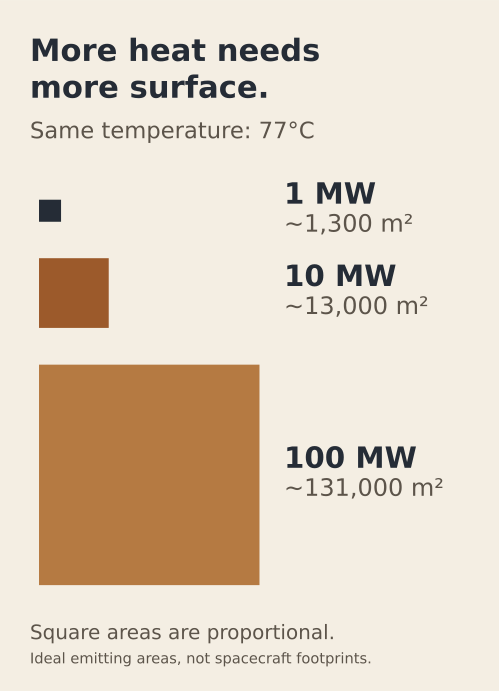
And the scale does not disappear when we stop looking at the drawing.
So why not turn the radiator up to a much higher temperature and shrink it?
Because the heat has to get there.
Without refrigeration, heat flows down a temperature gradient. The radiator must be cooler than the chip, with room for temperature drops through the chip package, cold plate, fluid, and panel. A chip that can tolerate a particular temperature does not give permission to operate its radiator at that same temperature. Junction-to-radiator constraints
The big wings are not just an artistic choice. They are connected to the temperature the computer can safely live with.
Five ways to make the problem smaller
The research gets interesting when it stops promising that cold space will do the work and starts changing the machine.
1. Move heat more efficiently
Ordinary liquid cooling lets fluid warm up as it carries heat away. Two-phase cooling also uses the energy absorbed when liquid boils and released when vapor condenses. Think of the energy a kettle consumes while water is already boiling: a phase change can take in heat without the same rise in temperature.
Microgravity complicates how bubbles and liquid behave, but this is not merely a proposal. A 2013 paper describes mechanically pumped carbon-dioxide loops cooling the AMS-02 particle detector on the ISS, reporting operation in space since May 2011. NASA and Purdue’s later Flow Boiling and Condensation Experiment has produced orbital measurements to improve the design of such systems. AMS-02 paper · NASA/Purdue findings
The limit: better transport gets heat to a radiator. It does not remove the need for one. Nor does a detector’s successful cooling system automatically establish a design for a much larger computer installation.
2. Unfold a bigger surface from a smaller package
A radiator can be large in orbit but compact inside a rocket. Heat pipes move heat by evaporating and condensing a fluid inside a sealed device. NASA describes a deployable radiator with heat pipes built into it, including flexible joints that carry heat across moving interfaces. Its assessment identifies the design as being tested and optimized. NASA’s deployable-radiator assessment
A separate November 2025 preprint studies structures designed to be stiff, lightweight, and good at spreading heat. This last property matters: a broad panel does little good if only a small patch gets hot. Lightweight-radiator study
These approaches work on different parts of the problem: packing volume, mass, and usable surface. None makes the required emitting area disappear. Hinges, plumbing, launch survival, and damage tolerance remain part of the finished product.
3. Use a refrigerator to make something hotter
Touch the outside of a working refrigerator near its heat-rejection surfaces and you may feel warmth. The appliance moves heat out of its cold interior and releases it somewhere warmer, using electrical work.
A spacecraft heat pump could do something similar: keep electronics cool while delivering their heat to a hotter radiator. The hotter surface could be smaller.
But the pump’s electricity also becomes heat. In this illustrative example, moving 1 MW of computer heat requires another 0.25 MW of electricity:
flowchart TD
  accTitle: A heat pump adds its own energy to the heat bill
  accDescr: One megawatt of computer heat plus a quarter megawatt of extra electricity requires the radiator to reject one and a quarter megawatts. This illustrative balance does not demonstrate a radiator area saving.
  A["INPUTS<br/>1.00 MW computer heat<br/>+ 0.25 MW electricity"] --> C["HEAT PUMP<br/>Delivers heat<br/>at a higher temperature"]
  C --> D["RADIATOR<br/>Rejects 1.25 MW"]
  class A anchor;
Energy-accounting example only: assumes a cooling coefficient of performance of 4. It does not specify an achievable temperature lift or prove a reduction in panel size.
A 2023 paper in Energies investigates the tradeoff. One modeled case, with a temperature lift near 60°C and a cooling coefficient of performance of 2.4, reduces required radiator area by a factor near 1.4: about 29% less area. Other combinations can make the radiator requirement worse. Heat-pump paper
This is a calculation to guide hardware choices, not a flight demonstration of a cooled AI facility. A smaller radiator must earn back the compressor’s mass, energy use, and potential failure points.
4. Replace the panel with droplets
The most visually arresting idea is a radiator made partly of moving liquid. Hot droplets travel through vacuum, emit radiation, and are collected for another trip through the system. The attraction is a large radiating surface without a solid panel everywhere.
There is real experimental work beneath the science-fiction appearance. A 2025 Applied Thermal Engineering paper measured the emissivity of individual silicone-oil droplets and tested a radiation model against laboratory measurements. Droplet experiment
That is evidence about droplets, not proof of an entire cooling plant. Long-term collection, evaporation losses, and keeping stray fluid away from optics and solar arrays still need answers. Much of this research concerns space nuclear power; its operating temperatures cannot simply be borrowed for GPU cooling.
5. Need less cooling for the same useful work
Perhaps the best radiator improvement happens inside the computer.
The June 2026 Space-CIM preprint examines compute-in-memory accelerators, which perform calculations within memory structures. In the workloads and configurations it simulates, these designs spread heat more evenly and deliver more operations per watt than the GPU comparisons under limited radiator capacity. Space-CIM paper
This is simulation evidence, not a universal replacement for GPUs. But it points toward a useful design question: how much useful work can a spacecraft perform with each watt it must later get rid of?
For a fixed task, fewer watts means a smaller heat burden. If the operator uses the efficiency gain to do more work, the total heat may stay the same.
A chip in orbit is a beginning
The evidence is no longer confined to laboratory benches. Starcloud reports that its Starcloud-1 satellite launched with an NVIDIA H100 GPU in November 2025, and trained the small nanoGPT model in orbit that December. Starcloud’s mission account
That matters. Running modern computing hardware in space is a milestone worth taking seriously. The mission description, however, does not provide the sustained megawatt-scale thermal measurements or lifetime costs needed to establish a large commercial facility.
Google’s Project Suncatcher offers another kind of evidence. Its research includes laboratory optical-link demonstrations and radiation testing of Google’s own AI processors, called TPUs. Its proposed satellites would use heat pipes and radiators. Google also lists thermal management and on-orbit reliability among the engineering challenges still to address. Suncatcher preprint · Google’s research account
A reader needs to keep three questions separate:
flowchart TD
  accTitle: Three different standards of proof
  accDescr: First establish that a computer can run and shed heat. Then establish that it can sustain service through faults and orbital conditions. Finally establish that useful computing can be delivered at a competitive price.
  A["CAN IT WORK?<br/>Run a computer and remove its heat"] --> B["CAN IT LAST?<br/>Sustain the workload through faults<br/>and changing orbital conditions"]
  B --> C["CAN IT COMPETE?<br/>Deliver useful computing at a price<br/>a customer will pay"]
  class A anchor;
Evidence for the first question does not automatically answer the next two.
This is where the skeptics have their strongest case. A large cooling structure must survive deployment, keep circulating fluid, and continue working after damage or component failure. Its mass must be launched along with power systems, computers, and communications equipment.
A 2026 preprint by Slava Turyshev combines these constraints. Its representative configuration for 1 MW of IT power requires about 2,500 m² of radiator area under its assumptions, including overhead and environmental effects. That figure is not inconsistent with our smaller ideal example: it describes a more demanding system boundary. The paper identifies processing data already generated in space as a more credible early use than general computing for users on Earth. Systems and economics analysis
That is a model to challenge and improve, not a verdict that closes the subject. For an Earth-observation satellite, processing an image nearby and sending down a useful result may have value even if orbit is an expensive place to compute. A service competing with a terrestrial data center has a different hurdle.
What would change your mind?
An impressive announcement can tell us how many chips someone hopes to launch. A useful demonstration would tell us what those chips did, for how long, at what temperature, and with how much supporting equipment.
Here is the scorecard I would keep beside the next announcement:
| Ask for this | It tells us this |
|---|---|
| Sustained useful workload and electrical draw | Whether the machine can do more than a brief demonstration |
| Heat rejected, plus chip and radiator temperatures | Whether the thermal system actually supports that workload |
| Total cooling-system mass | Whether the quoted weight includes pumps, pipes, hinges, shielding, and spares |
| Performance through orbital conditions and faults | Whether the system has operating margin rather than one favorable test point |
| Cost per useful computation over its lifetime | Whether cooling success becomes a business a customer will choose |
The promising work is less theatrical than the pitch: better heat transport, lighter structures, more efficient chips, and careful choices about which jobs belong in orbit. Those are testable improvements.
Return to the flask. The coffee stays warm partly because there is very little air to take its heat away. An orbiting computer faces a related inconvenience, then solves it with surfaces deliberately designed to send heat outward.
Space offers somewhere for that energy to go. The engineers still have to build the exit.
The numbers behind the pictures
Our charts use Q = ε × σ × A × T⁴, neglecting incoming heat from a near-zero-temperature background. Here, Q is heat flow in watts, ε is emissivity (0.90), A is total emitting surface in square meters, and T is absolute temperature in kelvin, not Celsius. We use σ = 5.670374419 × 10⁻⁸ W m⁻² K⁻⁴. NIST constants, page 44 · Radiation model
The exact temperature inputs are 300, 350, and 400 K, shown rounded as 27, 77, and 127°C (about 80, 170, and 260°F). For 1 MW of heat, the areas are 2,419, 1,306, and 765 m², rounded to the nearest square meter. The scale chart holds temperature at 350 K and changes only the heat load.
These are illustrative lower-bound calculations under the stated assumptions, not engineering designs, measured results, or radiator mass estimates. Two radiating faces contribute twice the area only if both have the assumed exposure and temperature. Real hardware requires a full heat balance and allowances for temperature gradients, incoming radiation, aging, and faults.
The heat-pump diagram is a separate illustrative energy balance: 1 MW of heat removed plus 0.25 MW of compressor electricity equals 1.25 MW rejected. The cited paper’s 29% area reduction comes from a different modeled operating point, not from that diagram.
Follow the evidence
For readers who want to go deeper, these are the most useful starting points. A preprint is a publicly shared manuscript; posting it is not evidence of journal peer review. Company reports describe the company’s own work, not independent validation.
| Starting point | What kind of evidence? |
|---|---|
| AMS-02 two-phase cooling system (2013) | Technical paper reporting flight operation |
| NASA/Purdue flow-boiling findings (2023) | Summary of completed ISS experiments |
| Heat pumps and radiator size (2023) | Journal paper; theoretical performance study |
| Individual-droplet radiation (2025) | Journal paper; laboratory experiment |
| Multifunctional lightweight radiators (2025) | Preprint; structural and thermal analysis |
| Space-CIM (2026) | Preprint; accelerator and thermal simulations |
| Google’s Suncatcher (2025) | Preprint; system proposal with component testing |
| Orbital constraints and economics (2026) | Preprint; system-level model and assumptions |
Illustrations were generated with ChatGPT and are labeled as concepts. Charts are calculated, not AI-generated. Diagrams simplify the heat flow and decision process. This article includes no reported interviews or reconstructed scenes; the household examples are explanatory analogies.