An Afternoon Does Not Need an Invoice
Why doing nothing can feel wrong—and what research on leisure, guilt, and recovery can actually tell us.
Imagine finding twenty minutes that nobody has claimed.
The urgent message has been answered. Nothing is boiling over. You sit outside. For a moment, the afternoon consists of weather, distant conversation, and the uneven shade of a tree.
Then a familiar question arrives: shouldn’t you be doing something?
You could answer another message. Listen to something educational. At least count the walk toward a fitness goal. The free twenty minutes begin to resemble an expense for which you have misplaced the receipt.
A post shared by Dkay captures that feeling. Its image questions why time spent quietly under a tree should need an economic or self-improvement justification. The image does not identify the passage’s original author, so the idea is worth discussing without inventing an attribution.
There are two different questions inside it. Can a pause do us good? And must a pause do something useful before we are allowed to enjoy it?
Science can help with the first. The second also asks what we believe a life is for.

The judgment can follow us into the break
In 2021, Gabriela Tonietto and colleagues reported four studies involving 1,310 participants. People who regarded leisure as wasteful tended to enjoy it less, particularly when they pursued an activity simply for pleasure rather than another goal. Research paper
The researchers also tested the direction of the effect experimentally. In one study, students read material framing leisure as wasteful—even giving that wastefulness a positive spin—before watching a funny video. They reported less enjoyment than a control group. Other experiments did not find that praising leisure as productive improved enjoyment over the control condition.
These are short, constructed experiences, not proof that one belief explains a lifetime of distress. Associations with anxiety and depression in the paper do not establish that leisure beliefs cause those conditions. The narrower finding is still useful: how we judge a break can affect how it feels. Study 4 and discussion, PDF pages 6–7
flowchart TD
  accTitle: A judgment can change the same leisure activity
  accDescr: In an experiment, students encountered a framing of leisure, watched the same funny video, and rated enjoyment. The wasteful framing reduced reported enjoyment compared with a control. This is a short-term experimental result.
  A["READ A FRAMING<br/>Leisure is wasteful<br/>or a control text"] --> B["SAME ACTIVITY<br/>Watch a funny video"]
  B --> C["REPORTED ENJOYMENT<br/>Lower after the<br/>wasteful framing"]
  class C anchor;
Simplified design of Tonietto and colleagues’ Study 4. It measures enjoyment, not an afternoon’s moral value.
The familiar advice to “rest so you can work harder” leaves an awkward possibility. We may carry the performance review into the park. Now the break has another assignment: produce a refreshed, improved person by the time it ends.
That is an interpretation of the dilemma, not a result the experiment measured. But it helps explain why this article will not offer a promise to turn every idle minute into future output.
A name for the unease
A newer paper, published online in July 2026, studies leisure guilt: unease about spending time leisurely instead of productively. Hyunjin Koo and colleagues developed a questionnaire and used repeated reports during daily life to examine the experience. Published abstract and bibliographic record
In the daily-life study, guilt occurred during an average of 14% of leisure occasions. That is a description of the sampled experiences, not a claim that 14% of all people feel guilty, or that everyone loses one-seventh of their leisure. Greater proneness to leisure guilt was linked with poorer leisure experiences and well-being.
This is recent evidence, and the published abstract supports a limited summary rather than a clinical diagnosis or a universal prevalence estimate. It gives a recognizable feeling a research name. It does not make everyone who checks a work message on Saturday a patient.
Some guilt points to a real unfinished obligation. Some persists after the obligation is handled. Those deserve different responses.
If a child is waiting to be collected, the problem is a commitment. If the child is safely home and you still believe sitting down makes you inadequate, the question has changed. The feeling alone cannot tell us which situation we are in.
Rest helps—but the sales pitch gets ahead of the evidence
Consider a more concrete question: what happens when people take a short break from a task?
A 2022 meta-analysis combined 22 independent samples with 2,335 participants. It examined micro-breaks, pauses of ten minutes or less. The pooled results showed small improvements in energy and fatigue. The overall performance estimate was uncertain: its confidence interval included no difference. Albulescu and colleagues, results and Table 3
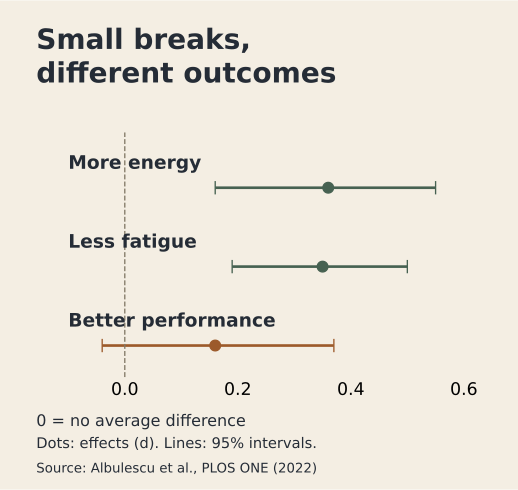
The chart’s scale puts unlike tests into comparable statistical units. An effect of 0.36 does not mean a 36% improvement. The intervals describe uncertainty around average effects, not the range of experiences an individual will have.
The studies used varied tasks and break activities. Their findings do not establish an ideal work schedule, and a brief laboratory pause is not the same as an uninterrupted afternoon. They do make an important distinction visible: feeling less tired and producing more are separate outcomes.
Suppose you return from a break feeling better but complete exactly the same amount of work. Has the break failed?
For a person concerned with how the day is experienced, that can be a success. No extra spreadsheet rows are required to recognize the difference. This is a value judgment, made openly, rather than hidden inside a scientific claim.
Leaving the desk is only one kind of leaving
You can close a laptop and continue an argument with its contents for the next hour.
Researchers distinguish being physically away from work from psychological detachment: mentally disengaging from it during non-work time. A 2017 meta-analysis covered 91 independent samples involving 38,124 employees. Greater detachment was associated with less exhaustion and better self-reported sleep and well-being, among other outcomes. Wendsche and Lohmann-Haislah
The relationships varied across studies and outcomes. Much of this evidence is correlational: healthier working conditions or better well-being can also make detachment easier. The review does not establish that refusing all thoughts of work is always helpful, or that switching off treats illness.
For everyday purposes, the distinction is more modest. A break on the calendar does not guarantee a break in the demands placed on a person.
flowchart TD
  accTitle: Time away and freedom from demands are different
  accDescr: An illustrative comparison distinguishes closing a laptop from remaining on call and from having a protected period away from work demands. It is not a measured causal pathway.
  A["LAPTOP CLOSED"] --> B["May still be on call"]
  B ~~~ C["PROTECTED TIME"]
  C --> D["No reply expected<br/>Thoughts may linger"]
  class D anchor;
An illustrative distinction, not a diagnostic test. Personal habits and actual job expectations both matter.
That is why an employer cannot solve an always-on culture merely by recommending meditation. If the unspoken rule is that every message needs a reply, the employee’s difficulty relaxing is not simply a failure of mindset.
Free time is not always free
The tree in the post is available to the imagination. An uninterrupted afternoon is not equally available to everyone.
The U.S. Bureau of Labor Statistics makes a useful distinction between childcare as a main activity and secondary childcare: having a child in one’s care while doing something else. In its 2025 estimates, adults living with children under thirteen averaged 1.9 hours a day of secondary childcare while engaged in leisure activities. The release notes missing time diaries during the 2025 federal shutdown and weighting adjustments. American Time Use Survey, childcare section and methodology note
Those hours are not proof that the adults felt stressed throughout. They show why a category labeled leisure should not automatically be read as uninterrupted freedom. Watching a film while responsible for a child differs from watching the same film while someone else is responsible.
flowchart TD
  accTitle: One hour can contain leisure and responsibility
  accDescr: A hypothetical hour watching a film can simultaneously involve being responsible for a child. The activities overlap; they are not two separate hours to add together.
  A["ONE CLOCK HOUR<br/>Watching a film"] --> B["ALSO RESPONSIBLE<br/>For a child in your care"]
  B --> C["OVERLAPPING TIME<br/>Leisure does not necessarily<br/>mean being off duty"]
  class C anchor;
Hypothetical example of overlapping activities; do not add the boxes as separate hours.
Money can sometimes change that constraint. In a 2017 experiment, sixty working adults in Vancouver received money for a time-saving purchase on one weekend and a material purchase on another, with purchase order counterbalanced across participants. Participants reported better end-of-day mood after the time-saving purchase. Whillans and colleagues, Study 8
It was a small, short experiment using provided money. It is not a reason to spend beyond one’s means. The practical issue is whether responsibilities can be reduced or shared, not whether everyone should hire help.
In a household, that might mean agreeing who is genuinely off duty. At work, it might mean covering a break rather than telling a colleague to take one while leaving every demand intact. These are proposals for creating room, not interventions established by that purchasing experiment.
The fair objection: we can waste time
The post is most persuasive as a challenge to compulsory usefulness. Taken literally as a claim that no time can be wasted, it goes too far.
We can miss a promise. We can keep scrolling long after we want to stop. We can spend an afternoon avoiding a small task until the avoidance becomes more unpleasant than the task itself. The earth keeps turning in each case; that does not erase the consequences.
There is also research that complicates “more free time is always better.” Marissa Sharif and colleagues analyzed two large U.S. datasets spanning 35,375 people and conducted two experiments. Having little discretionary time was linked with lower well-being, but more time did not bring unlimited gains. An abundance could also be associated with lower well-being. 2021 paper abstract
The experiments asked people to imagine different amounts and uses of free time; they did not assign people months of actual leisure. Meaningful uses mattered. These findings should not be converted into a universal daily allowance or used to tell an overworked person that they already have enough rest. UCLA’s account of the study
The useful distinction is between a chosen pause and time spent against one’s own intentions. Even that boundary can be blurry. A film can be pleasure on one evening and avoidance on another. The title of the activity will not settle the question.
A smaller question for the afternoon
Instead of asking whether every minute was productive, try asking what is actually needed now.
Is there a commitment that cannot wait? Does someone else believe you are available? Are you choosing this activity, or finding it hard to stop? Would a little quiet, company, movement, or sleep better meet the need?
These are reflection prompts, not a validated treatment or a new efficiency system. They are intended to make the choice more honest without requiring it to be impressive.
For a pause you can genuinely take, you might set a modest boundary: the message can wait until after lunch; another adult is covering the next half hour; the book does not need to become a review. Then let the experience be ordinary. It need not deliver an insight.
Sometimes rest will be pleasant. Sometimes it will feel restless. A disappointing break is not evidence that you have failed at leisure, and it need not become another project to optimize.
There is room here for ambition. Making things, caring for people, and doing difficult work can give a day meaning. The objection is to making measurable accomplishment the only acceptable meaning.
Research gives us reasons to take recovery seriously. It also gives us reasons to be cautious about the promises attached to it. Neither task requires turning a person into an appliance that earns maintenance only by producing more afterward.
Return to the imagined tree. The urgent responsibility is handled. Nobody has been left waiting. For a while, you are simply there.
The afternoon can belong to your life without becoming an invoice.
Follow the evidence
| Source | Contribution and limits |
|---|---|
| Dkay’s September 11, 2026 post | Starting image, inspected directly; original passage authorship unverified |
| Tonietto et al., 2021, Viewing leisure as wasteful undermines enjoyment | Surveys and short experiments; full paper inspected |
| Koo et al., July 25, 2026, Leisure Guilt | Questionnaire development and daily-life reports; published abstract used |
| Albulescu et al., 2022, Give me a break! | Meta-analysis of short breaks; main results and exclusions inspected |
| Wendsche & Lohmann-Haislah, 2017, detachment meta-analysis | Associations across employee samples; heterogeneous outcomes |
| BLS, American Time Use Survey, 2025 results | Official time-use estimates, including secondary childcare and shutdown caveat |
| Whillans et al., 2017, Buying time promotes happiness | Article uses the small spending experiment, not a financial prescription |
| Sharif, Mogilner & Hershfield, 2021, discretionary time and well-being | Observational datasets and imagined scenarios; abstract and institutional methods summary used |
Opening and household scenes are hypothetical. No interviews were conducted. The cover is AI-generated concept art; diagrams explain distinctions, and the chart reproduces published estimates. The argument that leisure need not justify itself through output is an editorial position, not a scientific measurement.