Are We Getting Older—or Just Getting Stuck?
Steve Jobs compared the mind to grooves in a record. Research on curiosity, learning, and late achievement suggests a more hopeful—and more demanding—picture.
Imagine that someone moves the mugs to a different cupboard.
The next morning, you reach for the old door. You know where the mugs are now. Your hand seems to have another opinion.
It is a small, familiar kind of being stuck. But it contains a puzzle: when does a useful shortcut become an obstacle? And is that obstacle the price of getting older?
A post from Startup Wisdom revives Steve Jobs’s answer. “People get stuck as they get older,” he said, comparing established thought patterns to grooves in a record. He went further, expressing doubt about how often artists in their thirties or forties make remarkable contributions.
The passage comes from David Sheff’s February 1985 Playboy interview. Its immediate context was a question about why computing attracted young people. Jobs was approaching thirty himself. This was a young entrepreneur’s interpretation of creativity, not the conclusion of an aging study. Interview transcript · Scan of the interview, PDF page 5
The image is memorable. A needle follows a groove; a person follows an established way of seeing.
The trouble begins when we mistake the metaphor for a life sentence.

A habit is an achievement before it is a problem
Imagine having to work out how to make coffee every morning: which cupboard, which container, which button. Familiar actions spare us that effort.
Psychologists Wendy Wood and Dennis Rünger describe habits as responses learned through repetition in recurring contexts. A familiar situation can cue an action without requiring a fresh decision each time. That helps explain the misplaced-mug problem. It also suggests why changing a habit may require changing its cues, rather than simply making a stronger promise. Psychology of Habit, 2016
flowchart TD
  accTitle: How a useful routine becomes automatic
  accDescr: A familiar cue prompts a practiced action. Repeating the action in that setting strengthens the cue-action association. When the situation changes, the old response may no longer fit.
  A["FAMILIAR CUE<br/>Morning coffee"] --> B["PRACTICED ACTION<br/>Open the usual cupboard"]
  B --> C["REPETITION<br/>The response gets easier"]
  C -. "Next morning" .-> A
  class B anchor;
Illustrative household example. A model of repeated behavior does not explain every entrenched belief or creative decision.
That distinction matters. Reaching for a mug, refusing to reconsider a business strategy, and struggling to learn a language are different problems. Calling all three “grooves” makes the conversation tidy, but the diagnosis less useful.
Experience itself is not the enemy. A carpenter who recognizes a weak joint, or an editor who notices an unsupported claim, is drawing on patterns worth keeping. The useful question is whether a pattern still matches the situation—and whether we notice when it does not.
The brain has no single peak birthday
One reason the aging story becomes confusing is that we talk about intelligence as though it were a battery indicator. Full at twenty. Half-full at fifty. Almost empty later.
Research does not support that single dial.
In a 2015 study, Joshua Hartshorne and Laura Germine combined standardized-test data with results from 48,537 online participants. Different abilities followed different age patterns. Processing speed peaked relatively early; vocabulary and some other abilities reached their strongest performance later. The study compared age groups, so its curves should not be read as an individual person’s future timetable. Research paper
| What a task asks of you | Why one “peak age” is misleading |
|---|---|
| Respond quickly to simple information | Speed can change differently from knowledge |
| Hold and manipulate information briefly | Working-memory demands are distinct from accumulated expertise |
| Understand words and draw on experience | Learning over many years can remain valuable |
Conceptual guide to different demands, not a diagnostic test or a numerical forecast. Based on the distinctions examined by Hartshorne and Germine.
Consider the person learning a new piece of software after years in an industry. They may struggle with the interface while immediately recognizing which customer problem is worth solving. A colleague may master the interface quickly and need help understanding the customer.
Neither person can be reduced to a single score called potential.
A city provides a better metaphor than a record
London’s prospective taxi drivers offered researchers a demanding test of adult learning. They had to acquire a detailed mental map of the city.
Katherine Woollett and Eleanor Maguire followed male trainees over three to four years. Those who qualified showed an increase in gray-matter volume in the posterior hippocampus, a brain region involved in memory; comparable changes were not found in the returning unsuccessful trainees or controls. The study tracked the same people over time, although it did not randomly assign them to succeed. 2011 paper, methods and results
This is evidence of adult structural plasticity: the brain can change with sustained learning. It is not evidence that a scan can identify new neurons, or that bigger always means better. Successful trainees also performed worse on a test asking them to remember a complex visual figure after a delay. The change was specialized, not a universal upgrade.
flowchart TD
  accTitle: What the taxi-driver study can and cannot establish
  accDescr: Researchers assessed trainees before and after years of training. Qualified trainees showed localized brain and memory changes. This supports adult adaptability, but does not establish a general intelligence boost.
  A["BEFORE<br/>Brain and memory tests"] --> B["YEARS OF LEARNING<br/>London's street layout"]
  B --> C["AFTER<br/>Localized changes<br/>in qualified trainees"]
  C --> D["CAREFUL CONCLUSION<br/>Adults can adapt<br/>in specific ways"]
  class D anchor;
A city makes room for both persistence and change. Old roads remain useful. New connections can be built. Traffic does not move equally well everywhere, and construction takes work.
That is still a metaphor. But it leaves room for the limits and possibilities the evidence actually shows.
Curiosity depends on what you ask
Here is a deceptively simple question: are older people less curious?
A 2025 preregistered study by Mary Whatley and colleagues separated two meanings of the word. In its final sample of 1,218 U.S. adults aged 20–84, older age was associated with lower trait curiosity—people’s general description of how curious they are. Yet it was associated with higher state curiosity: interest in learning the answers to particular trivia questions. PLOS ONE paper
flowchart TD
  accTitle: Two ways to ask about curiosity
  accDescr: General self-reported curiosity was lower at older ages in the 2025 sample, while interest in specific trivia answers was higher. These were associations across people, not measurements of the same individuals aging.
  A["GENERAL TENDENCY<br/>How curious am I?"] --> B["Lower at older ages<br/>in this sample"]
  C["SPECIFIC QUESTION<br/>Do I want this answer?"] --> D["Higher at older ages<br/>in this sample"]
  B ~~~ C
  class D anchor;
Directional summary, not effect sizes. The study compared different people; it cannot establish that aging caused either pattern.
Even the general-tendency side is not a single thing. A July 2026 study of 75 younger and 80 older adults broke curiosity into several dimensions. Older adults scored higher on enjoyment of exploration, while younger adults scored higher on thrill seeking and some other dimensions. This smaller questionnaire study does not overturn the earlier result; it shows how much depends on what a curiosity scale includes. Hirsch and colleagues, published abstract
A practical inference is to begin with a question that matters to you, rather than decide whether you possess a permanently curious personality.
“I should learn more about technology” is an obligation with no obvious finish line. “Why did my electricity bill rise when I used less power?” gives a person something to investigate.
The second question may lead to tariffs, seasonal charges, household equipment, or a mistake. It creates a reason to look closely. It also gives the answer a place to go.
Curiosity is not identical to browsing. Opening twenty tabs can feel like exploration without resolving anything. A question becomes useful when we let an answer change what we understand.
Interest helps. It does not do the learning for you
In a 2014 laboratory study, Matthias Gruber and colleagues asked participants to rate their curiosity about trivia questions. Memory was better for answers to high-curiosity questions; participants also remembered some incidental material better. Brain-imaging results linked these benefits with activity in memory and reward-related regions. Neuron paper
That is an intriguing clue about motivated learning. It is not a direct measurement of dopamine release, a guarantee that every interesting lesson will stick, or evidence that curiosity prevents dementia.
Think of interest as a reason to enter the workshop. You still have to use the tools.
The Synapse Project tested something closer to a sustained activity. Of 259 older adults enrolled, 221 completed a 14-week program. Demanding activities included digital photography and quilting. The photography condition produced an episodic-memory benefit compared with a social condition, among other comparisons. Episodic memory concerns remembering particular events and information encountered. Park and colleagues, 2014
The program involved substantial time and structured support. Its results should not become “buy a camera and reverse aging.” Nor should they become a judgment about people who cannot spare many hours each week.
The more defensible lesson is that learning a real skill can still produce gains later in life. We must specify the gain, the activity, and the conditions under which it appeared.
Getting better at the game is not getting better at everything
This is the trap waiting on the optimistic side of the argument.
Once we hear that the adult brain can change, it is tempting to believe that any difficult puzzle will improve the whole machine. Researchers call the leap from a practiced task to a different ability transfer.
A major 2016 review of brain-training studies found strong evidence for improvement on practiced tasks, less for closely related tasks, and little for distant tasks or everyday cognitive performance. The review also identified substantial study-design weaknesses. Simons and colleagues
The National Institute on Aging likewise distinguishes evidence for particular cognitive-training interventions from claims made for commercial brain-training apps. Its guidance does not treat all programs as interchangeable. NIA cognitive-health guidance
That gives us a sensible standard: if you practice photography, first ask whether your photographs improve. If you study a language, ask what you can understand or say. Claims about a general increase in intelligence need additional evidence.
Learning something useful is already worthwhile. It does not need a promise to rejuvenate every part of the brain.
Remarkable work does not belong to one decade
Jobs’s comment about artists was a sweeping claim about creative contribution. A memory experiment cannot settle it. Neither can a list of famous late bloomers: selecting successful people after the fact tells us little about everyone’s odds.
Entrepreneurship offers a different, measurable test of the broader youth-only story.
Pierre Azoulay and colleagues studied U.S. Census administrative data covering about 2.7 million founders of businesses that hired employees. The average founder age was 42; for the one-in-a-thousand fastest-growing ventures, it was 45. NBER research summary · 2020 journal publication
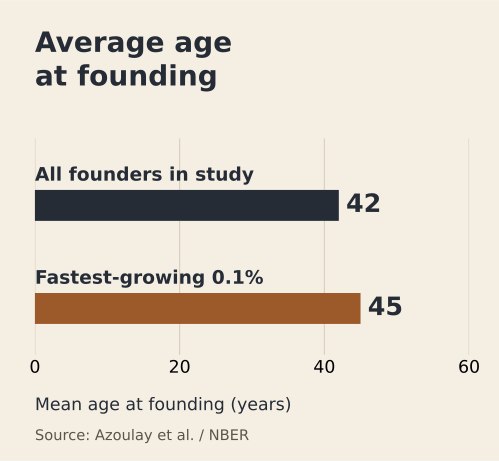
These are not data about painters or every kind of startup. Age can travel with experience, resources, contacts, and selection into entrepreneurship. The study does not show that a birthday causes success. It does make it harder to defend the general claim that important new work belongs primarily to the very young.
Jobs’s own later career supplies an irony rather than a statistical proof. He was 51 when Apple introduced the iPhone in January 2007. It was the achievement of a large team, not a solo act of genius. Still, the man who worried about fixed patterns at nearly thirty helped lead consequential work decades later. Apple’s announcement · Birth date, Computer History Museum
Make room for being a beginner
There is a kinder question than “Have I wasted my potential?”
What would I like to understand well enough to do something with it?
The following is a practical framework drawn from the distinctions above, not a tested treatment or a promise about brain health. Choose a small task whose result you can inspect. A working spreadsheet. A repaired object. A short explanation someone else can follow.
flowchart TD
  accTitle: A small, testable learning cycle
  accDescr: Choose a meaningful question, try a small task, compare the result with evidence or feedback, and revise before trying again. This is an editorial framework, not a clinical intervention.
  A["ASK<br/>What do I want<br/>to understand?"] --> B["TRY<br/>Make something small"]
  B --> C["CHECK<br/>What worked?<br/>What surprised me?"]
  C --> D["REVISE<br/>Change one approach"]
  D --> B
  class C anchor;
Give the task a boundary. Instead of “become technical,” make one small tool that solves an actual annoyance. Instead of “become creative,” make three versions of something and explain why they differ.
Protect room for mistakes. If your first attempt has to prove that you are still intelligent, it becomes much harder to inspect what went wrong. The purpose of a first attempt is to reveal the next thing you need to learn.
Use expertise without making it untouchable. Write down what you expect to happen before you try an unfamiliar approach. If the result disagrees, investigate the disagreement. You do not need to discard years of experience; you need a way to update it.
And acknowledge the conditions around the learner. Someone caring for a parent, working irregular shifts, or managing a disability may need time, access, money, or accommodation. A slogan about curiosity cannot supply those things. Difficulty finding room to learn is not evidence of a defective character.
We do change as we age. Some abilities become harder to call on. Some knowledge becomes more useful. Particular forms of learning remain possible, and the results depend on more than enthusiasm.
Jobs’s warning is most useful when it prompts us to examine a familiar response. It is least useful when it becomes an age limit on other people’s possibilities.
Keep the experience. Test the assumptions. Open another cupboard.
Follow the evidence
| Source | What it contributes |
|---|---|
| David Sheff, Playboy, February 1985: interview scan | Historical quotation and context; a third-party-hosted copy of the original interview |
| Wood & Rünger, 2016: Psychology of Habit | Research review of repetition, cues, and automatic behavior |
| Hartshorne & Germine, 2015: cognitive abilities across the lifespan | Different age patterns across different tests; mainly age-group comparisons |
| Woollett & Maguire, 2011: London taxi training | Longitudinal adult brain and memory measurements |
| Whatley et al., 2025: state and trait curiosity | Preregistered observational study; questionnaire and trivia task |
| Hirsch et al., 2026: perceptions of curiosity in older age | Smaller questionnaire and qualitative study; different dimensions give different age patterns |
| Gruber et al., 2014: curiosity and learning | Laboratory memory tests and functional brain imaging |
| Park et al., 2014: Synapse Project | Structured learning intervention in older adults |
| Simons et al., 2016: brain-training review | Critical evaluation of claims that training transfers to other abilities |
| Azoulay et al., 2020: age and high-growth entrepreneurship | Administrative-data study; business outcomes, not artistic creativity |
The opening is a hypothetical household example. This article contains no reported interviews or reconstructed scenes. The cover is AI-generated concept art; the chart reproduces published summary values, and the diagrams are explanatory. Research on learning is not a promise of dementia prevention or a substitute for individual medical care.